Sam Meade | Relationship Development Manager
If you work in appointeeship or deputyship you’ll know this one. Someone is referred to your team, the DWP needs somewhere to pay their benefits, and the client doesn’t have a passport or a driving licence. Quite often there’s no utility bill in their name either, because somebody else has always dealt with that side of things.
Banks have to verify identity before they open an account. That’s a legal requirement under the anti-money laundering rules, and fair enough. The trouble is that the usual way of meeting it assumes a fairly ordinary life, with photo ID, a fixed address and a credit file.
A lot of the people our partners support don’t have that. Some have lived in supported accommodation or a care setting for years. For others the documents went missing at some point and nobody ever replaced them.
What usually happens next
The deputy or appointee starts building a paper trail. Letters from the care provider, a letter from the local authority, a birth certificate if one turns up. Then a branch appointment, sometimes two. Sometimes the bank accepts it. Sometimes the application disappears into a team nobody can phone, and comes back weeks later asking for something else.
Meanwhile the client’s money still has to go somewhere. Usually that’s an existing account the team would rather not be using, or a holding arrangement that makes year-end reconciliation harder than it needs to be. Nobody involved is doing anything wrong. It’s just slow, and slow has a cost when it’s someone’s rent or care fees.
How we do it instead
We designed Monika’s onboarding around that client from the start, rather than bolting on a workaround for them later.
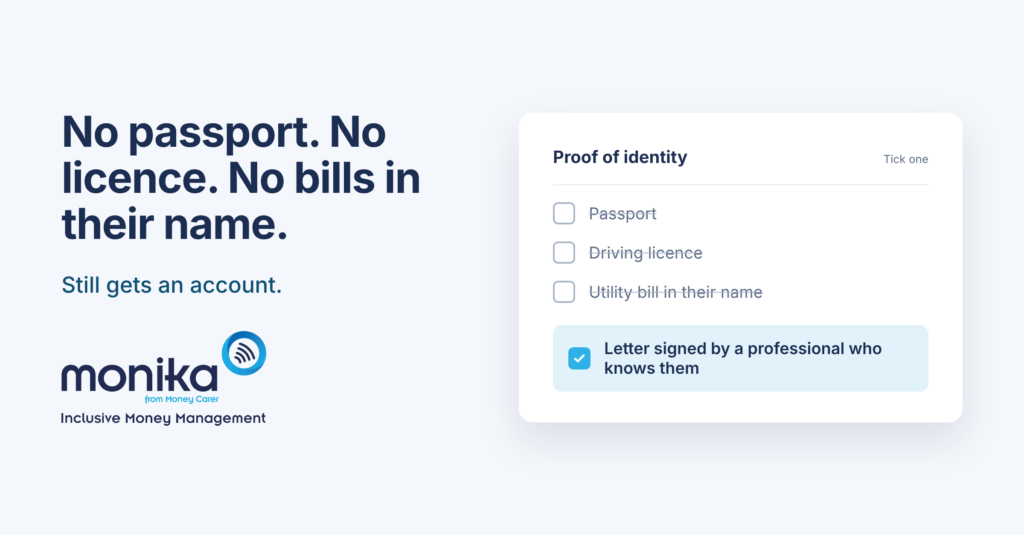
Instead of asking the client for documents they don’t have, we verify identity through a letter signed by a nominated professional who knows them. The letter follows a set template, so the person signing knows exactly what they’re confirming and we know exactly what we’re getting.
That’s the identity check. The client doesn’t go to a branch, and the team doesn’t spend a week on the phone.
It’s still a proper check, and the account still carries FSCS protection up to £120,000 like any other. What changes is what we accept as evidence. For this group of clients, a professional who has actually met them tells you far more about who they are than a photocopy of a document they’ve never owned.
Why it matters beyond the paperwork
It’s easy to see account opening as admin, the bit you get through before the real work starts. I’d argue it’s nearer the other way round.
Without an account in their own name, a client has no transaction history, so there’s nothing to evidence a care assessment or a court report with. Bills can’t go on direct debit, so they tend to end up on the dearer tariff. Cash gets handled by whoever happens to be nearest. None of that is dramatic on its own, but it adds up, and it makes the rest of the job harder for everyone including the client.
Opening the account quickly doesn’t fix all of that. It does give the rest of the safeguarding work something to stand on.
If the client already has an account
Sometimes it’s the opposite problem. The client has an account, but it’s with a bank that isn’t set up for a team managing it on someone’s behalf. Then the Current Account Switch Service does most of the work: balances, direct debits and standing orders move across within seven working days under the Current Account Switch Guarantee. We’ve written about that in more detail here.
Seeing it with your own caseload
If onboarding is where your team loses the most time, we’d be glad to walk through it using a real example from your caseload. It takes about 30 minutes. Book a demo.